
How to Actually Find the Best A/L Combined Maths & Physics Classes in Sri Lanka
I did my Combined Maths A/Ls back in 2022, and watching my younger brother Dasun suffer through his classes now for his upcoming batch makes me realize how much worse they have it. The syllabus changes from a few years back are fully settled in, and the exam schedules keep shifting, so the tuition timeline feels way more compressed than what I dealt with. Watching him and his friends try to pick classes reminded me how confusing the whole thing is when you're in the middle of it. Every tuition master has a Facebook page now. Every other ad claims that teacher produced half the district ranks last year. Parents get anxious, students get overwhelmed, and plenty of families end up paying for classes that looked impressive on a flyer but turned out to be a waste of two years.
My own experience, plus what I've seen with Dasun and his batch, keeps coming back to the same thing: the teachers who actually get results don't need to run ads. The parents and students do the marketing for them, through WhatsApp groups, through school connections, through neighbors quietly passing on a name. My family found our Combined Maths teacher because my mother's colleague, Aunty Nilanthi, had a son named Sahan who got into Moratuwa Engineering the year before my A/Ls. She gave us the contact directly at some office function. No Facebook page, no flyer, just a phone number passed between two mothers. Since most people don't have an Aunty Nilanthi to give them a direct contact, finding a reliable teacher online is a total nightmare. Honestly, using a tutor directory like TuteClass just to filter people by location and get a basic shortlist is way safer than blindly trusting Facebook flyers. Combined Maths and Physics are a different level from other streams. The classes aren't cheap, the commitment is two full years, and if you pick wrong, you don't get a do-over.
What I Learned About Combined Maths Teachers
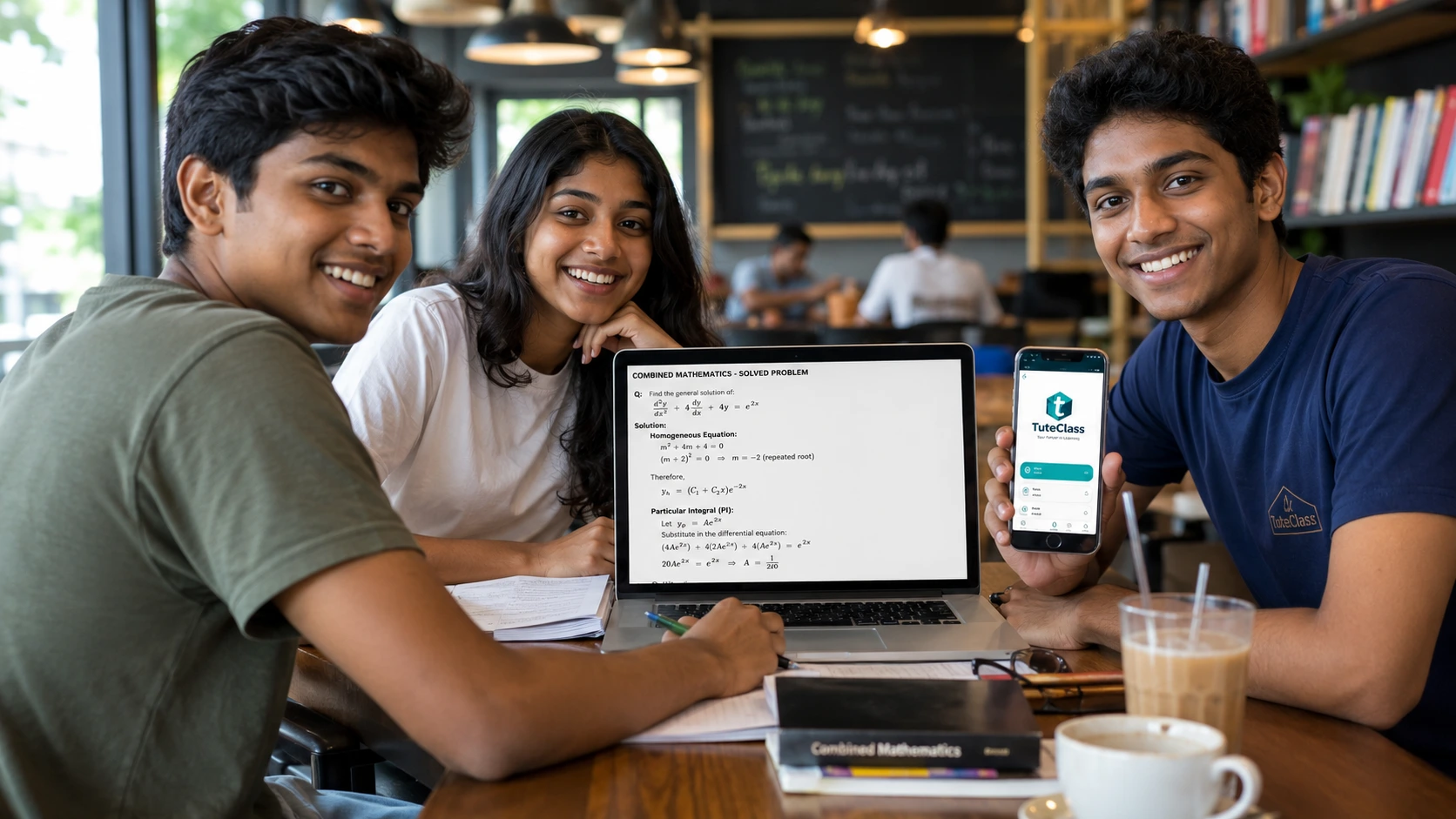
Parents obsess over degrees. First class this, PhD that. I get it. But the best Combined Maths teacher I ever sat with, a man named Siripala sir who teaches out of a small room near Thurstan Road in Colombo 07, had none of the flashy credentials parents usually look for. No projector, no printed notes, just a whiteboard and a marker that kept running out of ink halfway through class. The room was above a small bookstore, maybe twenty students maximum, and you had to climb this narrow staircase to get there. First few weeks were rough. He'd spend forty minutes on a single Pure Maths proof, stopping every few steps to ask someone directly, "Why are we allowed to do this substitution? What's the assumption we're making here?" He'd call on people by name, so there was no hiding. You had to think or get embarrassed in front of everyone.
I was frustrated at first because my school friend Ravindu was in one of those big mass classes near Nugegoda, you know the type, and his batch was already three past papers ahead while we were still deriving theorems from scratch. I kept asking my mother if we'd made a mistake, if I was falling behind. But when the actual A/L exam came, I understood what those slow forty-minute sessions had done. There was a Pure Maths question where I completely blanked on the formula. In O/Ls that would have been the end. But because I'd watched Siripala sir build that derivation from the base up so many times, I could reconstruct the whole thing step by step. I walked out with an A in Combined Maths. Without those classes, honestly, I would have scraped a C. Maybe a B if I got lucky. The jump from O/Ls to A/Ls catches so many students, and I've already seen it happen to smart kids in Dasun's batch. In O/Ls you can memorize your way to good marks. A/L Combined Maths doesn't let you do that. By the second term, the questions stop following the patterns. Examiners have gotten smarter about testing whether you actually understand the concept or just memorized last year's format. A good teacher forces you to make that transition early. A bad one lets you coast until you hit the wall alone. If you look at the wider tuition landscape, the gap between O/L and A/L classes isn't about harder content. It's a completely different way of thinking, and your teacher either builds that bridge or watches you fall into the gap.
When you go for a trial class, watch how the teacher handles problems where Pure and Applied Maths overlap. Mechanics questions that need calculus. Those turning-point problems. A good teacher stops and talks through why they chose that specific method and what the alternatives would be. A weak teacher projects a PDF on the wall and reads the solution aloud like a voiceover. If you see that, don't sign up. Don't care what their flyer says about district ranks.
Physics Classes: The Two Traps
Here's a massive mistake I made that almost ruined my Physics paper: I fell into the MCQ shortcut trap. My first Physics teacher drilled nothing but multiple choice. Every class was shortcuts, elimination tricks, pattern recognition drills. My paper scores looked decent during the term because I got fast at spotting the right bubble without understanding the physics behind it. Then the structured essay section hit during mid-year mocks and I couldn't explain a single concept properly. The examiner doesn't care if you circled the right multiple-choice answer if you can't show the working behind it. I had to switch classes mid-stream to a teacher near Kirulapone, which cost extra money and a lot of stress catching up on the proper theory I'd completely missed. Don't put yourself in that position. It's expensive and demoralizing.
I've seen the opposite problem too. My school friend Kavindu, who lives up in Kandy, studied with a former Peradeniya lecturer named Dr. Samaraweera. His approach makes parents nervous when they first hear about it. First three months, no past papers. Not one. Instead, the students use their phone sensors to log acceleration data from objects dropped off tables. They build basic circuits on breadboards to measure internal resistance. They set up ripple tanks to actually watch wave interference patterns form and move. Kavindu told me his parents nearly pulled him out after the first month because other classes around Kandy were already on their fifth past paper while his batch was still doing what looked like O/L practicals. But when they finally started past papers, the structured essay questions felt almost straightforward. They'd seen how the physics actually behaved in real life. He ended up with a district rank and got into Peradeniya Engineering. Took serious nerve to trust that process though. Most parents I know would have panicked and switched classes by week six.
Dasun uses Khan Academy's Physics section and MIT OpenCourseWare for topics where his teacher rushes through or his notes aren't clear. Both are free and solid for building conceptual depth, especially on tough topics like electromagnetism where a different explanation sometimes makes things click in a way your class notes didn't. Just keep in mind that these are university-level resources. You'll need to filter what's actually relevant to our local syllabus rather than trying to work through everything they have.
Something else nobody warns you about is making sure your Physics and Maths teachers actually stay in sync. Simple Harmonic Motion is the obvious example. Your Physics class introduces oscillations and restoring forces, and around the same time, your Combined Maths teacher should be doing the differential equations behind SHM. When those two line up, everything clicks together naturally. When they don't, you end up learning the same concept twice in isolation without connecting them. I wasted hours trying to understand SHM separately in two subjects when it was the same thing described two different ways. A teacher who points out those connections saves you an enormous amount of wasted effort. That kind of coordination is what smart A/L subject planning is about. Not just picking subjects that look good together on paper but making sure they actually reinforce each other in practice.
Electricity and Magnetic Fields is where weak teaching really shows. If your teacher draws flat 2D diagrams on a whiteboard and moves on, you're in trouble when a 3D flux question shows up in the structured essay. I've seen it happen to people. Look for classes that use simulation software or actual lab demonstrations for fields and flux. Being able to see the vectors in three dimensions, to visualize how changing the angle affects the flux through a surface, that visual memory is often what saves you under exam pressure when your brain is exhausted and you're running on instinct. Siripala sir had a simple PhET simulation he'd pull up on a laptop just for the 3D field visualizations. Took five minutes but made the whole topic stick in a way the whiteboard never could.
Online vs Physical: What I've Seen With Dasun's Batch
When I did my A/Ls in 2022, online classes were still recovering from the COVID chaos. Shaky webcams pointed at whiteboards, audio cutting out halfway through derivations, no proper way to ask questions without disrupting the whole lecture. Dasun's experience now is completely different. The good online classes use proper digital tablets with clear feeds, dual-screen setups so you see both the teacher and the board, and moderated WhatsApp or Telegram chats where assistants answer questions during the lecture. Most importantly, they give you full recordings afterward. If you zone out for thirty seconds in a physical class, that explanation is gone forever. With recordings, you can rewind and rewatch until it actually makes sense.
But there's a downside to online that I didn't fully appreciate until I watched Dasun struggle with it. Physical classes give you something no screen replicates: the energy of a room full of people grinding through the same problem. When you're exhausted and want to give up, looking around and seeing everyone else still working pushes you forward. Dasun started with online classes to avoid the commute. By the second term, his discipline was slipping. He'd wake up late, skip the live session, tell himself he'd catch up on the recording later. Later kept not happening. We switched him to a physical class at a place near our home in Dehiwala, not a famous name, just a solid teacher with a small group. The difference was immediate. Just being in a room with other people working hard pulled him along.
The tradeoff in Colombo is the traffic, and it's no joke. High-Level Road at 4 PM. Baseline Road near the hospital. The stretch through Nugegoda junction. You can lose two hours easily just getting to class and back. Over two years, that's hundreds of hours sitting in a bus or a three-wheeler. Some people handle it fine. Ravindu used his commute time to review notes on his phone. Others burn out completely. Dasun couldn't handle the commute to a central Colombo class, so we found something closer even though the teacher was less famous. His marks actually improved because he arrived fresh instead of already drained. You have to be honest about what works for you specifically, not what sounds good on paper.
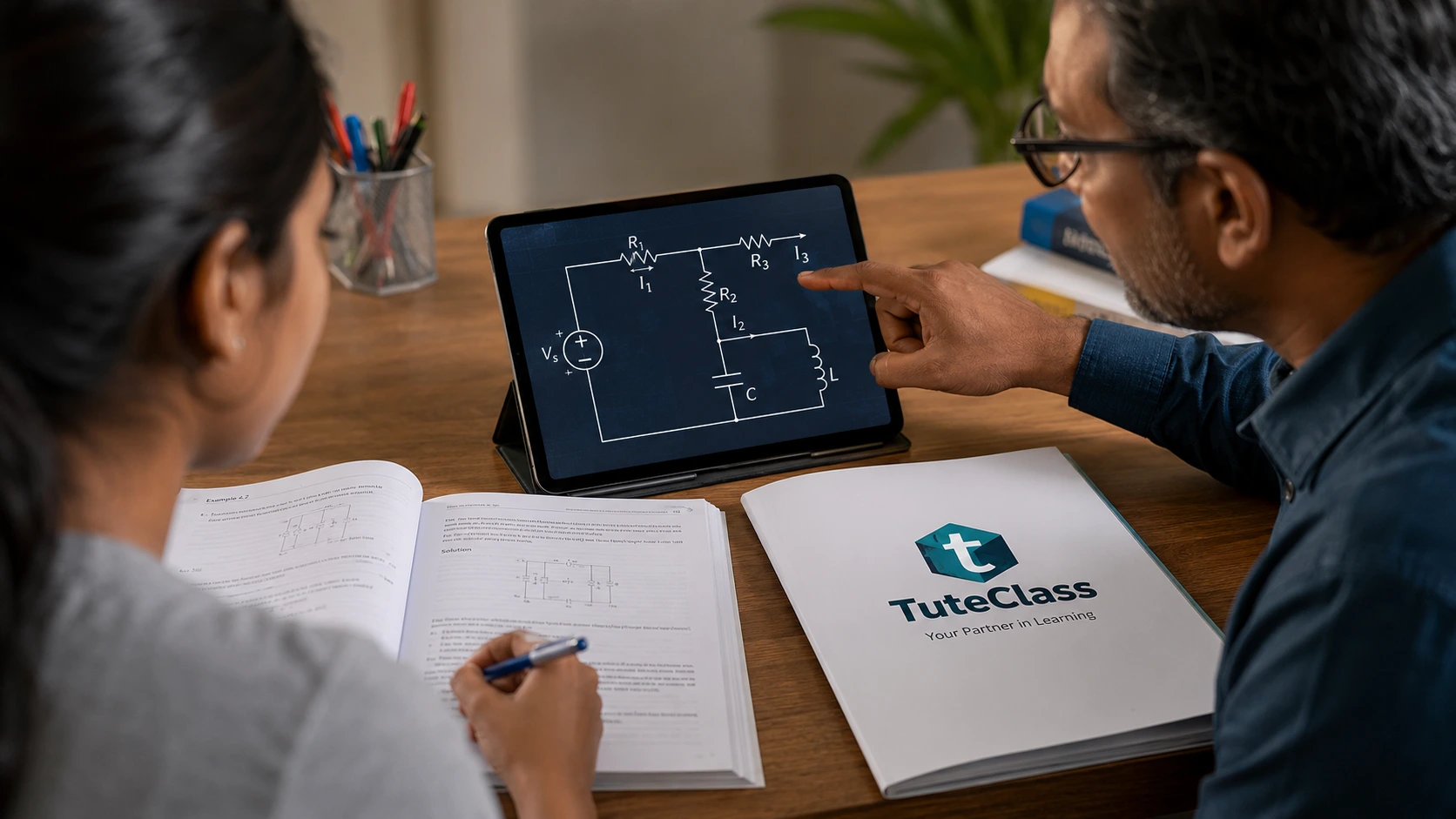
Online or physical, the thing that actually determines your results is whether the teacher marks your papers properly. I've seen famous teachers with packed halls who collect homework and return it with nothing but a tick and a total mark. That's completely useless. You don't know where you went wrong or how to fix it, so you carry the same mistakes into the exam. Before committing to any class, ask to see marked papers from current students. Look at the feedback with your own eyes. If there are no corrections, no margin notes, no indication of which step went wrong and why, find another class. My cousin Dilshan studies in a small group near Galle Fort, run by two young graduates from Moratuwa and Ruhuna who operate out of a rented room near the old Dutch Hospital area. They cap at fifteen students and won't expand. He showed me one of his marked papers last time I visited. Every mistake was circled in red. The correct approach was scribbled in the margin. At the bottom the teacher had written: "Dilshan Integration steps are fine, but you are completely careless with minus signs in the final lines! Re-do trig substitutions from last week and show me problems 4-7 before next Tuesday." In a hall of three hundred at some mass class in Colombo, nobody notices the minus sign you dropped in line four. In a group of fifteen, those things get caught early. They also connect every topic to real applications. When they teach complex numbers, they show how an electrical engineer uses the same math to analyze AC circuits. That kind of context keeps you going when the material gets abstract and you start wondering what the point of any of this is.
Trial Classes and What to Check
Never pay for a full term without sitting in on a class first. Any decent teacher allows this, usually for a small fee. During that trial, watch how the teacher handles questions from students. If someone raises their hand and the teacher gets irritated, dismisses it, or says "I already covered that" in an annoyed tone, pay attention to that reaction. It tells you everything about what the next two years will feel like. A good teacher takes a few minutes to explain differently without making the student feel stupid. The best ones actually thank the student because three other people were confused about the same thing but were too nervous to speak up.
For Combined Maths, check if they show multiple methods for the same integral. Different problems need different approaches, and if you've only seen one way, you'll freeze when that method doesn't fit. For Physics, check if they use practical examples when explaining real versus ideal gases, not just textbook definitions. Also check the physical space. Lighting, board visibility from different seats, sound quality, whether the room gets stuffy after an hour. I sat in a class near Bambalapitiya once where the AC was broken for three weeks straight and the room was so packed I couldn't see the bottom third of the board. You stop learning about forty-five minutes in and just endure the rest. That's not a learning environment. Ask directly about how they track your progress against the rest of the batch. Your Z-score depends entirely on your rank against everyone else taking the exam. A teacher who gives you raw marks without telling you where you stand in the batch is hiding something. The honest ones tell you directly: you're in the top twenty, your mechanics is strong but probability needs work, here's what the students ahead of you are doing.
The Z-Score is All That Matters
Parents get fixated on a teacher's name and ignore everything else. But the name doesn't matter if the learning environment works against you. Visit the class yourself. Check the ventilation, the board visibility from the back corners, the sound. Two years in a bad room takes a toll you don't notice until results come back lower than you expected. Find a teacher who talks about Z-score constantly, not just pass rates. I've seen classes around Nugegoda and Kirulapone proudly advertise that most of their students passed. When you dig deeper, you find out most of those passes were C grades. That won't get anyone into a competitive program. Ask specifically about A grades and district rank improvements. How many actually got into Moratuwa or Peradeniya last year? If the teacher dodges the question or gives you vague percentages, keep looking.
If you're totally starting from scratch without any word-of-mouth recommendations, use a site like TuteClass just to look up who is actually qualified in your area before wasting your time traveling to trial classes. Filter by subject, check their background and what they specialize in, and at least build a shortlist of people worth visiting. It beats calling random numbers off Facebook ads and hoping for the best.
Don't Rush This
Ignore the marketing. Talk to students currently studying with the teacher, not just ones who got results years ago when things might have been different. Sahan's recommendation worked for me because he'd just finished his A/Ls. If someone is quoting results from 2020, those conditions may not apply anymore. Look at corrected papers yourself. Check if the feedback is detailed or just tick marks. Match the teaching style to how you actually learn. Dasun thrives in a smaller setup where someone catches his mistakes. Ravindu did fine in a packed Colombo mass class. Neither is better in absolute terms, but picking the wrong environment for your personality makes two difficult years much harder than they need to be.
A/Ls are going to be tough no matter what. The right teacher doesn't remove the difficulty. But they make the struggle feel like it's going somewhere, like you're building toward something. Ask hard questions at trial classes. Pay attention to how they answer. Walk away from anything that doesn't feel right, even if everyone else is signing up. Your university entrance, and honestly your sanity for the next two years, depend on getting this decision right.