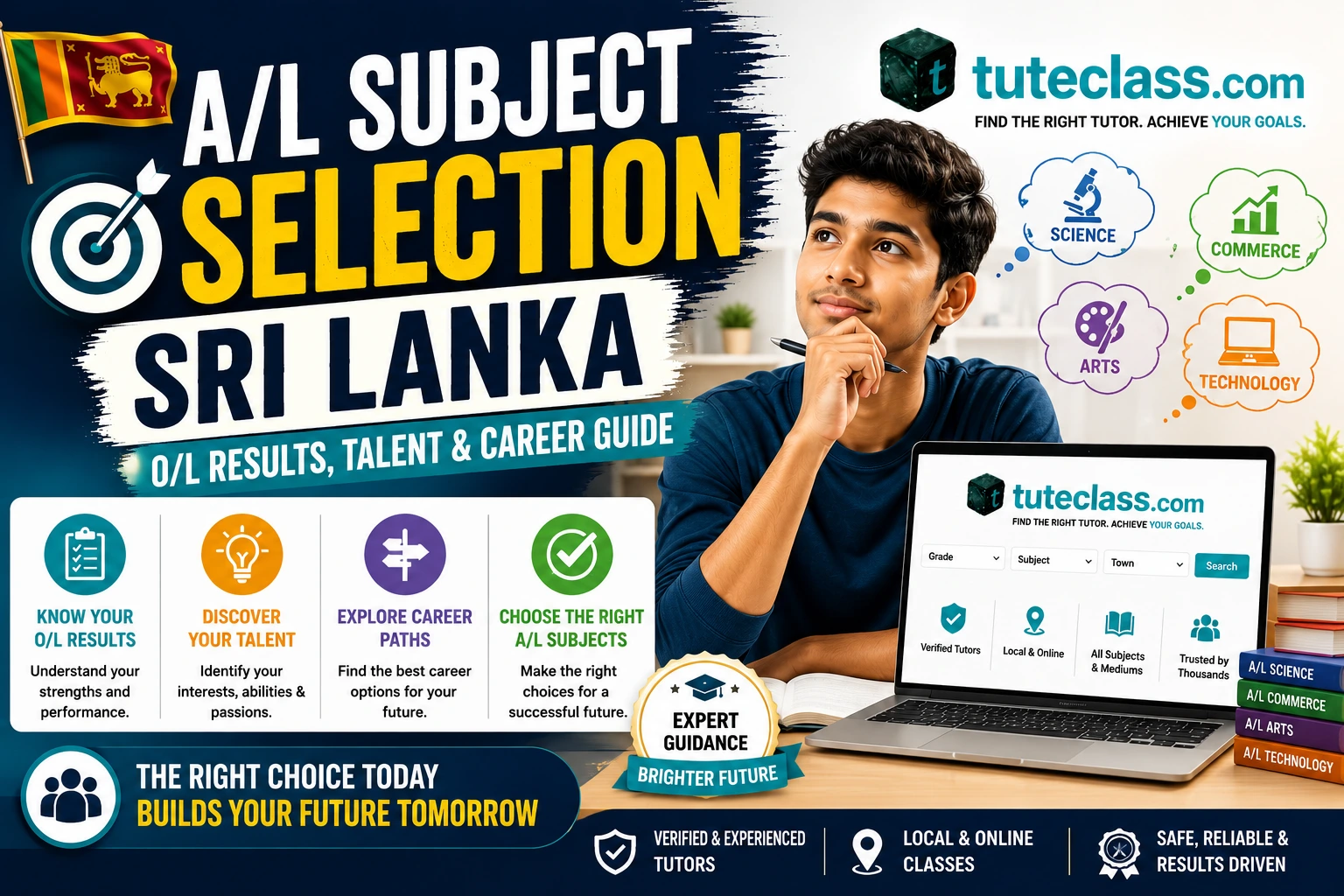
A/L subject selection is one of the most important decisions for Sri Lankan students and their families.
A/L subject selection is one of the most important decisions for Sri Lankan students and their families.
Sometime in Grade 10 or 11, most Sri Lankan households have the same conversation. O/L exams are approaching or just finished. Suddenly, the question of "what next" lands on the dinner table. Relatives call with opinions. Neighbours mention what their son did. Somewhere in all that noise, the student's own voice gets quiet. I've seen it happen so many times now I can practically predict the script.
I sat across from one father in Nugegoda. He told me, flat out, "My daughter got 8 As. Science is the only option." I asked what she wanted. He looked at me like I'd asked something irrelevant. The daughter sat next to him, staring at the floor. That image stayed with me, not because it was unusual, but because it was so painfully familiar. I've had some version of that conversation maybe two hundred times. It never gets easier to watch.
The 2026 reforms are shaking things up with five streams now, as Vocational Studies joins Science, Technology, Commerce, and Arts. More choice sounds good on paper, but here's the thing nobody says out loud: more choice means more room for confusion if nobody actually thinks through what fits the student. Most families have zero tools for this. They're running on outdated information, pressure from relatives, and a lot of fear. If you're trying to figure out how to support your child through this, our guide on what Sri Lankan families look for in a tutor covers similar ground on understanding individual student needs.
Let's be blunt. O/L results open some doors and close others. Not an opinion. Just how the system works. Six credit passes to even sit for A/Ls, including compulsory subjects like Mathematics, History, and First Language. That's the floor. Not the ceiling. Each stream has its own thresholds. Some of them are brutal.
Science gets tight fast. Biological Science wants at least a B in both Maths and Science. Physical Science, the Combined Maths route, usually demands an A in Mathematics. No A? That engineering path is closed. Finished. I've watched parents argue with principals about this. "Just give the child a chance." The rules don't bend. I've also seen what happens when a child with a C in Maths gets pushed into Physical Science anyway through some connection. They drown. Not because they're not smart. Because they were set up to fail from the start. Commerce is broader. Five credits, with a pass in Maths or History or Accounting. Less restrictive. That's why so many students flow into it when Science isn't possible. Or when Science was never what they wanted but nobody asked. Arts has the widest door. Five credits. Fail O/L Maths? You can still enter Arts, but you'll re-sit Maths in your first A/L year. That rule tells you everything about what this system values and what it doesn't.
The Z-score is the ranking mechanism for university admission. Brutal at the top. Medicine and Engineering take only the highest Z-scores. A student can pass A/Ls comfortably and still not get into their course. The University Grants Commission publishes cut-off marks. Look for "Admission to Undergraduate Courses" on ugc.ac.lk. It lists minimum Z-scores for every course and university. Most families don't check these until results come out. Too late. I've had parents in my office in January, A/L results released, discovering for the first time their child's Z-score won't get them into medicine. The grief in that room. I don't want anyone else going through that.
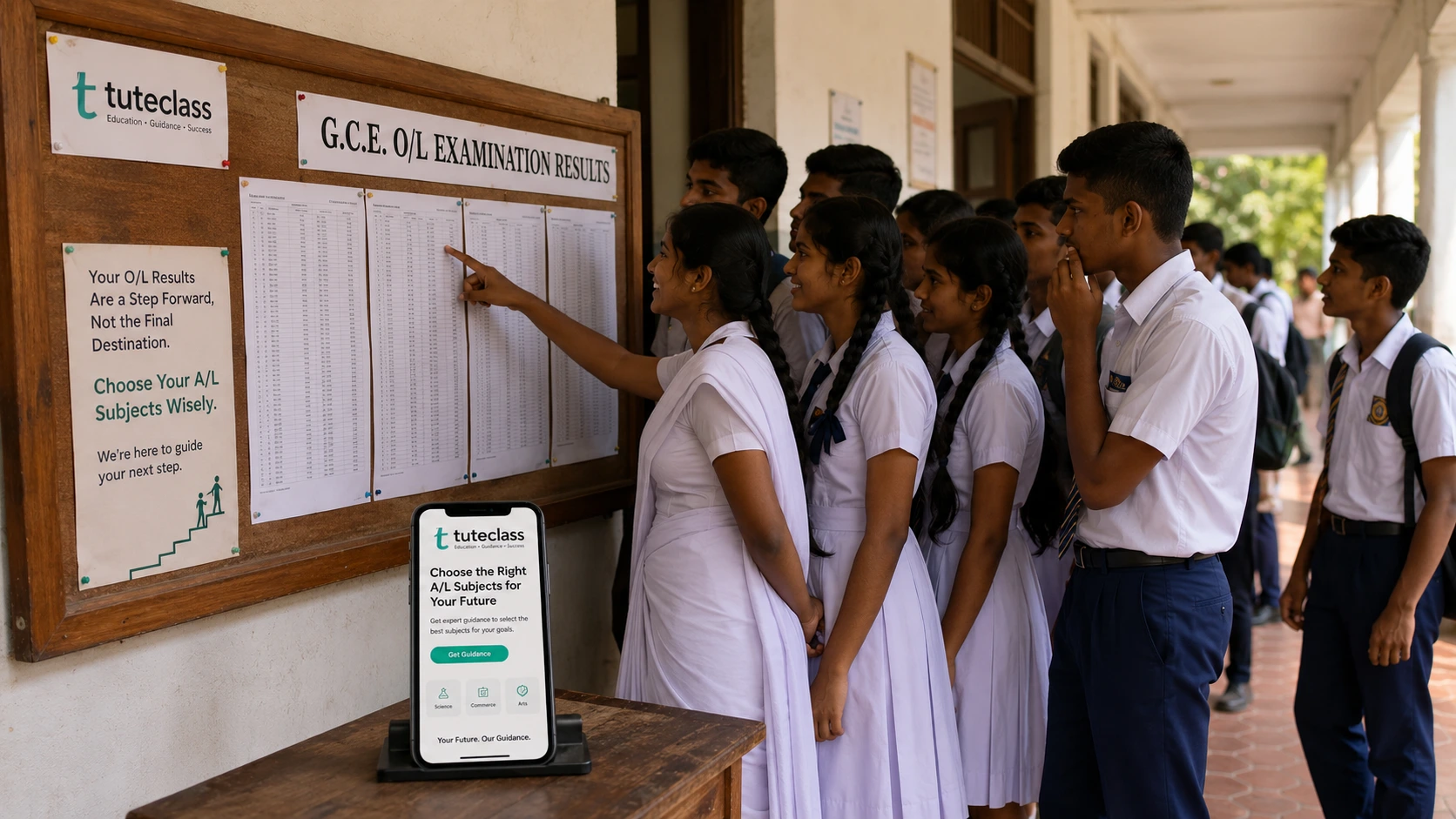
O/L results set the boundaries for A/L eligibility, but they can't tell you where a student will actually thrive.
O/L results measure what a student could memorise and reproduce under exam conditions. That's it. They don't capture whether someone can debug a computer, write a story that holds attention, or look at a broken appliance and instinctively know how to fix it. Some of the most talented students I've met had thoroughly average O/L results. The system wasn't designed to see them.
Parents and students constantly mistake strong interest for genuine talent. A boy loves watching cricket. Dreams of playing professionally. Put him under pressure and his hand-eye coordination falls apart. That's interest. Not aptitude. Hard truth. Another student finds accounting painfully boring but has an almost intuitive grasp of numbers. That's talent, whether he likes it or not. I worked with a boy who hated commerce subjects. Complained every single session. He could look at a balance sheet and spot discrepancies experienced accountants missed. His father wanted him in IT. We had to have a very uncomfortable conversation about the difference between what you enjoy and what you're actually built for.
When you're trying to figure out where a student actually fits, don't guess. Ask yourself: do they improve faster than their peers? Does the work energise them, even when it's difficult? If the answer is yes, that's not just a hobby. That's a path. Get feedback from someone qualified in that field, not from parents or friends who love the student too much to be objective. The "lose track of time" test matters, but with a caveat. Lots of people lose track of time playing video games. Doesn't mean they have a talent for game design. The real question: do they lose track of time during the hard parts, or only the fun parts? I learned this the hard way. Encouraged a student toward graphic design because she loved sketching. She only loved the initial creative rush. The detailed revision work made her miserable. She's in marketing now. Much happier.
Groups like Future Lanka Research & Development Foundation run career guidance programs at schools like Good Shepherd Convent and Yashodara Devi Balika Vidyalaya. They focus on identifying strengths before choosing streams. The fact that these programs exist and are filling up tells you there's a hunger for something beyond the standard advice. If you're looking for tutors who can provide this kind of individualised attention, TuteClass can connect you with teachers who specialise in specific subjects. For tutors who want to help families navigate this, our article on how to get more tuition students in Sri Lanka covers building trust during this critical period. Trust is the foundation. Without it, none of these conversations go anywhere.
From 2026, Vocational Studies is now a formal fifth stream. These reforms come from the Ministry of Education's "National Education Policy Framework 2023-2030." The Department of Examinations has the circulars. The National Institute of Education at nie.ac.lk publishes curriculum frameworks for each stream.
Still the most competitive. Biological Science for medicine, pharmacy, veterinary science. Physical Science for engineering and physical sciences. Entry requires B or above in O/L Maths and Science. A in Maths for Physical Science. Z-score pressure is immense. Only a tiny fraction get their first-choice course. I don't say this to discourage anyone. I say it because pretending otherwise sets families up for pain.
Engineering Technology, Bio Systems Technology, ICT. B in Maths and Science, five credits. I've watched students who found Combined Maths too abstract absolutely thrive here. The learning is more applied. More hands-on. Companies don't care whether you came through Science or Technology. They care if you can do the work. The degree matters less than the portfolio.
Accounting, Business Studies, Economics. Five credits. Solid route into chartered accounting, banking, management. Often treated as the default middle option when Science isn't possible and Arts seems too uncertain. Treating it as a fallback is a mistake. A student with zero interest in numbers will struggle here just as badly as an unwilling Science student. There is no safe option that ignores the student's actual wiring.
Let's get one thing straight about the Arts stream. People treat it like a dumping ground for students who couldn't make it into Science. That's not just wrong. It's lazy thinking. I've seen Arts grads run circles around engineers. The subjects? Diverse. Languages, history, geography, political science, logic, music, art. You need five credits to get in. From there, you're looking at law, journalism, teaching, or public administration. Some subjects like Economics demand high Z-scores, sure. Others, like Music, aren't about the raw marks. They're about pure, demonstrated aptitude. Forget the idea that the stream sets your ceiling. It doesn't. The student does.
This deserves real attention. Most families don't understand what's actually included. Construction and Built Environment: masonry, carpentry, plumbing, electrical, surveying. Leads straight to employment or diplomas in civil engineering. Creative Industries: graphic design, video production, animation, fashion. Direct links to media companies and the freelance economy. Primary Industries: agriculture, horticulture, livestock, fisheries. Treats farming knowledge as a foundation, not a dead end. Hospitality and Tourism: food production, hotel operations. Applied IT: hardware, networking, basic programming. Practical skills without the theoretical depth of a full degree.
Vocational Studies is not terminal. Read that again. A student can complete the pathway, work, earn money, and later pursue further qualifications through the University of Vocational Technology at uovt.ac.lk or NAITA at naita.gov.lk. The pathway doesn't close. It branches.
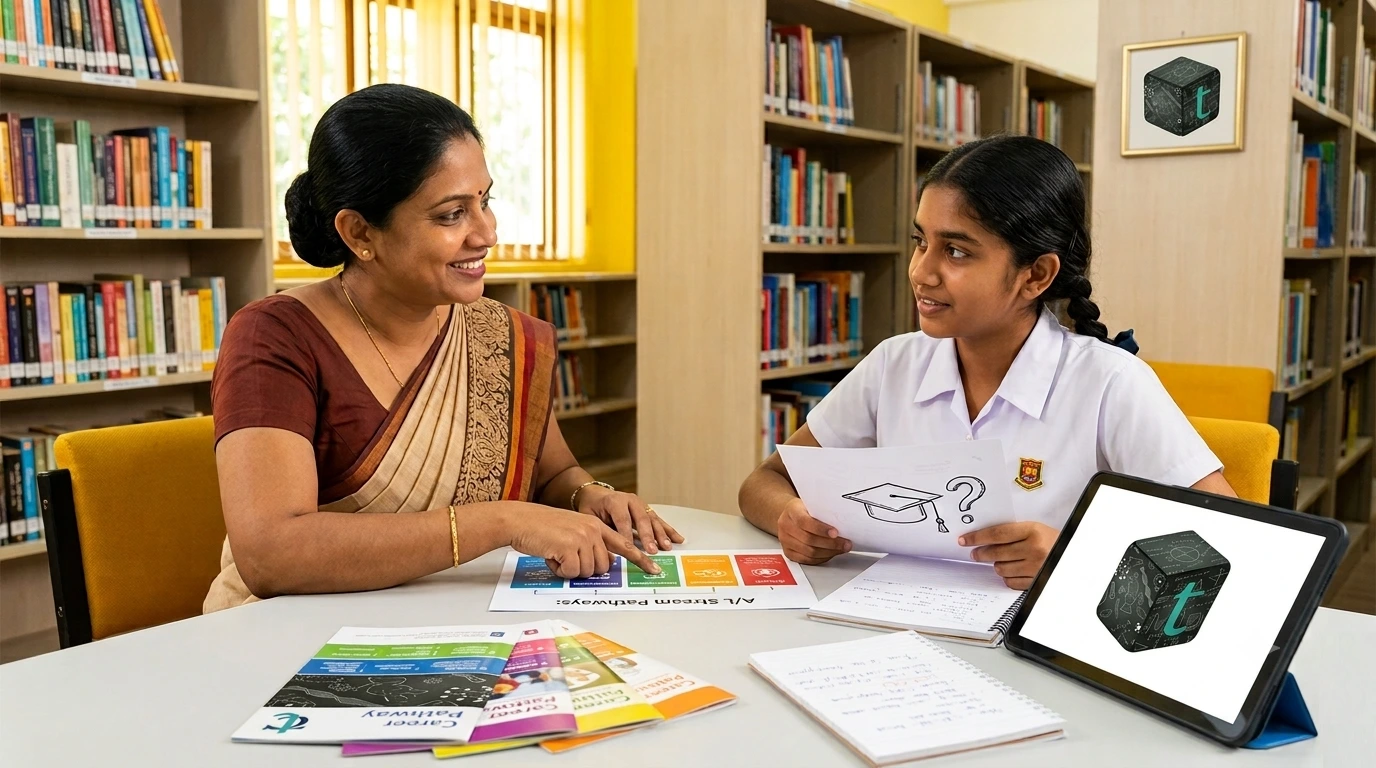
Career guidance that looks beyond grades is still not standard in many schools, but it makes all the difference.
I asked a group of Grade 10 students what they wanted to do after A/Ls. "University," they said. I asked what course. Dead silence. Nobody had asked them what job they actually wanted. That silence. That's the sound of a system failing its students.
Start with the work. What does the student find meaningful? Doctor? Must take Science. No way around it. Lawyer? Arts is the most direct path. Software developer? Technology, Science, even Commerce with ICT. The pathways are more flexible than families assume. The UGC Undergraduate Admission Handbook on ugc.ac.lk is the single most useful document you'll find. Click "Admissions," then "Undergraduate Admissions." It lists every course, every university, and the minimum Z-scores from previous years. The Department of Examinations has official subject syllabuses. Download them. Read them. They show exactly what will be taught and tested over two years. Beyond all the websites and PDFs, find someone actually working in the field. Talk to them for 30 minutes. Ask what their day actually looks like. That conversation teaches more than any website ever will.
Already settled on a stream? Our guide to Grade 5, O/L and A/L tuition classes walks through evaluating teachers and finding the right fit. The 2026 reforms should improve career exposure through the new Further Education Curriculum. I've been around long enough to know systems change slowly. The gap between policy and practice has always been wide. Don't wait for the school. Go find it yourself.
Telling a Sri Lankan parent "I don't want Science, I want Arts" with no preparation? Like walking into an exam without studying. You need a strategy. I've helped enough students through this to know what works and what backfires.
Parent worried about prestige? Don't argue. Redirect. A student I worked with last year handled this beautifully. She told her father: "Law is one of the most competitive and respected fields in Sri Lanka. I can get there through Arts. Here are the Z-scores for law admission. If I take Science and perform poorly because my heart isn't in it, I won't get into any university. If I take Arts where my strengths are, I have a real shot." Her father paused. He hadn't considered that angle. Present the alternative as equally prestigious. Back it with evidence. Not emotion. Parent worried about job security? Acknowledge it. Another student showed his mother job listings for IT graduates. "Companies are hiring straight out of university. Salaries are good. Technology stream with ICT gets me there." He came prepared. Changed the conversation.
The relatives issue is real. Give your parents a narrative. "We can tell them I'm specialising in IT. Fastest-growing sector in the country. This isn't a step down. It's a different direction with good prospects." Give them the words. They'll use them. Direct conversation failing? Bring in a third party. A trusted tuition teacher. A school counsellor. An older cousin who survived A/Ls recently. I've watched a 20-minute talk with a respected tutor achieve what months of arguments at home couldn't. Goal isn't confrontation. It's showing you've thought seriously about your future. Parents push back hardest when they think you're making a casual decision. Remove that impression. The conversation changes. Not always. Often enough.
Choosing Science for prestige. Student has a C in Maths. Parents insist anyway. "What will people say?" Two years of struggle. Low Z-score. No university placement. If they'd taken Commerce or Technology, they might have excelled. Pride destroys judgment. I've seen this too many times. Parents living through their children. Father who wanted to be an engineer thirty years ago. Mother denied higher education. The child becomes a vehicle for adult regrets. Destroys motivation. Destroys relationships. Destroys confidence for years afterward. The parents think they're being practical. They're not. Following friends. Whole group picks Commerce. Student follows. Six months later, miserable. Friendships change. Subject choices shouldn't depend on them. Assuming you can switch later. Technically possible. Bureaucratic. Time-consuming. Often means repeating a year. I've seen students spend Grade 12 in Science, realise it's wrong, move to Commerce in Grade 13, cram two years into one. Some pulled it off. Most didn't. The system is not designed for flexibility. School limitations. Rural students often have no access to Technology or Science streams. Arts or Commerce only. Not the student's fault. Systemic problem. Some students face genuinely limited choices through no fault of their own. Best we can do is help them navigate within those constraints rather than pretend they don't exist.
Start with a conversation that doesn't mention streams. Ask what the student actually enjoys. Not what teachers praise. What makes them lose track of time, even the hard parts. Be brutally honest about the difference between fun and real aptitude. Be honest about O/L results. Not as judgment. As reality. C in Mathematics? Physical Science isn't happening. Accept it early. Prevents wasted years. Research careers. UGC Handbook at ugc.ac.lk. Department of Examinations syllabuses. Talk to real people working in the field. Consider non-university routes seriously. Vocational stream isn't a consolation prize. For the right student, it's faster to employment than a degree they never wanted. If your parents are pushing the wrong direction, prepare your case. Evidence. Allies. An alternative, not just resistance. Let the student have the final say. Parents provide boundaries. The student wakes up every morning and studies these subjects for two years. A student who chooses their own path works harder. Always. I've watched it enough times to stop calling it a theory.
I think back to that girl in Nugegoda. Eight As. Staring at the floor while her father decided her future. I don't know what happened to her. I've met enough students like her to know the two outcomes. Some comply. Struggle through a stream they never wanted. Spend years undoing the damage. Others find the courage, sometimes quietly, sometimes only after everything falls apart, to say "this isn't for me." The difference comes down to one moment. Whether someone asked what they actually wanted. And then actually listened. Not nodded while thinking about something else. Actually listened. Be the parent who asks. Be the student who speaks. Everything else is just details.