
What Sri Lankan Families Look for in a Tutor: What Actually Matters in 2026
I run a tuition platform in Sri Lanka. Every day I watch parents browse through tutor profiles, and it took me a long time to understand what I was seeing. Some profiles get messages. Most get ignored. For a while I thought I knew why. Better qualifications, more experience, a nicer photo. But after a few years of this, I realised I was wrong. Most parents aren't reading tutor profiles the way HR managers read CVs. They're trying to figure out something much more personal. Can I trust this person with my child? Not just with their grades. With their confidence. With those two hours a day when someone else's voice is in their head. Everything else comes after that. And most tutors never address it at all.
I wrote about this earlier in a piece on how to get more tuition students in Sri Lanka without boosting ads. That was about where to show up. This is about what to show when you do. The small things that make a parent pause, read, and eventually send you a message.
How Sri Lankan Parents Choose a Tutor in 2026
Ten years ago, a parent chose a tutor because the neighbour said so. That still happens. But something else is happening too, and it is growing. Parents with smartphones are researching. They scroll through profiles after dinner, when the house is finally quiet and everyone else has gone to bed. Some of them spend weeks comparing tutors before sending a single message. They open three or four profiles in different tabs. They read every word. They never call you first. They send a message, sometimes days or weeks after they first saw your profile. That gap is decision time. And during that gap, your profile is doing all the talking.
Sri Lanka's private tuition sector is massive. UNESCO has documented how private investment in supplementary education has become a significant part of household expenditure across South Asia, with Sri Lanka being no exception. World Bank has also noted the growing reliance on private tutoring alongside public education in the country. More money means more scrutiny. A parent who is stretching their budget to pay for tuition is not going to hand their child over to a stranger with a phone number and a subject name. They want to know who you are before they ever speak to you. If your profile doesn't tell them, they move on. No second thought. No callback.
I remember watching one mother in Colombo spend forty minutes comparing two profiles. Both tutors taught the same subject. Both had degrees. One got the message. The other didn't. The one who got the message had written a few lines about how she handles students who are struggling. That was the only real difference. The other profile was just qualifications listed one after another. That small human detail tipped the decision. I've seen versions of this same moment more times than I can count. The tutors who win are not always the most qualified on paper. They're the ones who give a parent enough to feel something.
Students are watching too. Teenagers scroll through profiles on their own phones. They notice whether a tutor looks approachable. They read between the lines of the bio. They can tell if someone is going to make them feel stupid for asking a basic question. And if they get that feeling, they mention it to their parents. Casually. Over dinner. "I don't think I'll like that sir." And that tutor never hears from them. The decision was made before a single word was exchanged.
How a Combined Maths Tutor in Gampaha Attracted More Students
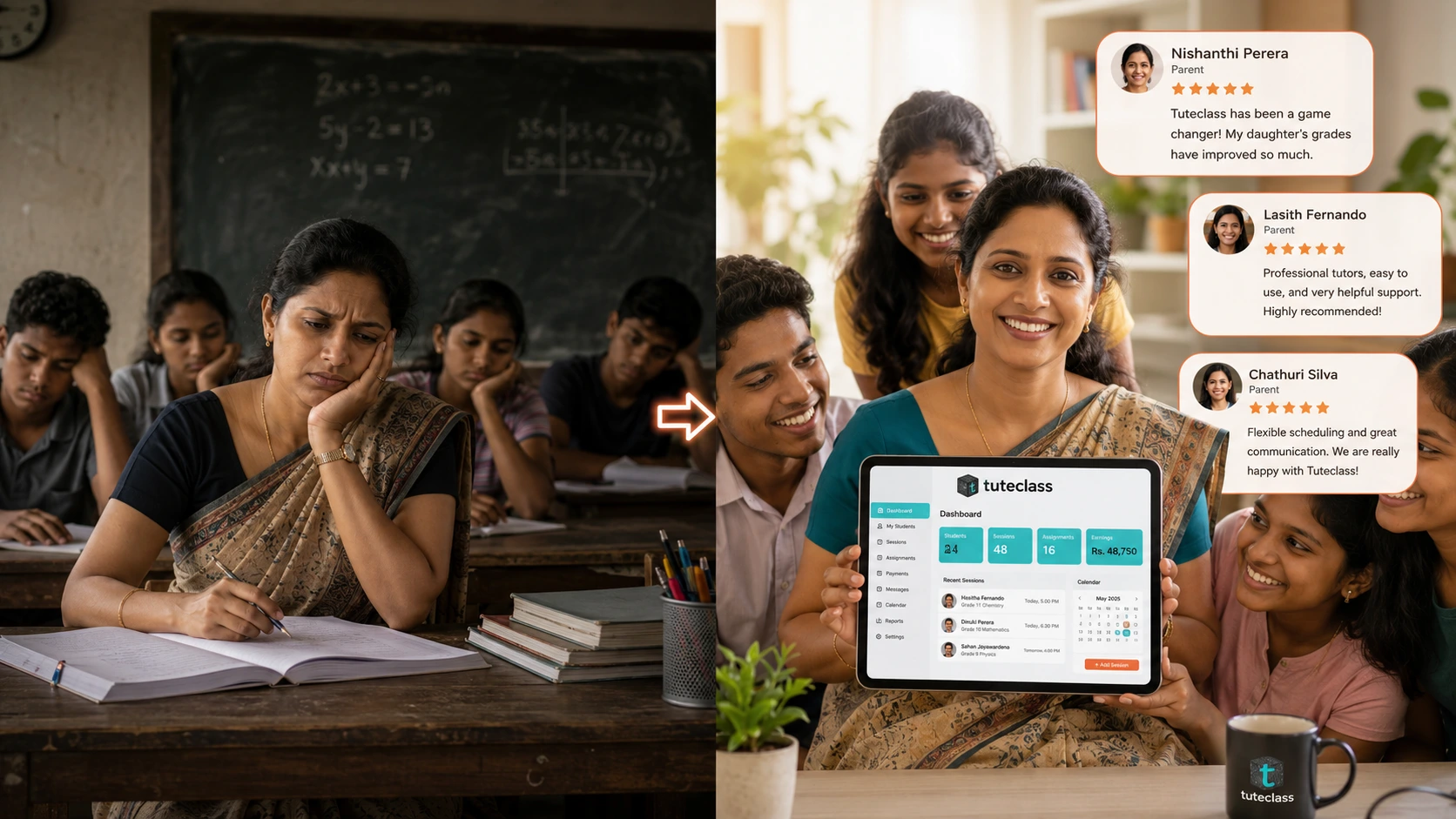
There is a Combined Maths tutor in Gampaha who started using Tuteclass a few years ago. She had been teaching for three years and never had more than about ten students at a time. She was frustrated. She had tried Facebook ads. Spent money. Got a few likes. Nothing turned into actual students.
At some point she sat down with two of her former students and asked them directly. Why did you stay? Why did others leave? One of them told her something that surprised her. In the very first class, she hadn't smiled. The student assumed she was angry about their weak basics and nearly didn't come back. Another mentioned that their mother had looked at her profile online and found almost nothing. Just a name and a phone number. The mother hesitated for two weeks before even calling.
She told me later that updating the profile felt awkward. Like she was trying to sell herself. But she did it anyway. She added a proper photo where she looked warm rather than stiff. She wrote a few lines about why she enjoys teaching. She asked one parent if they would write a short note about their child's progress and put that up too. Nothing dramatic happened overnight. But within a few months, her profile views started climbing. Enquiries came in from families who would never have found her before. She eventually filled her class and opened a second batch.
I'm not going to claim that fixing your profile guarantees results. That wouldn't be honest. I've seen tutors improve their profiles and still grow slowly. Competition is real. Subject demand varies. Location matters. But here is what I've noticed again and again. Your profile won't create demand where none exists, but it can absolutely lose you students who are already looking for exactly what you offer. That is what happened with this tutor. The demand was already there. Parents were searching. Her old profile just gave them no reason to choose her. Once she showed them who she actually was, they responded.
What Parents Look for in a Tuition Teacher in Sri Lanka
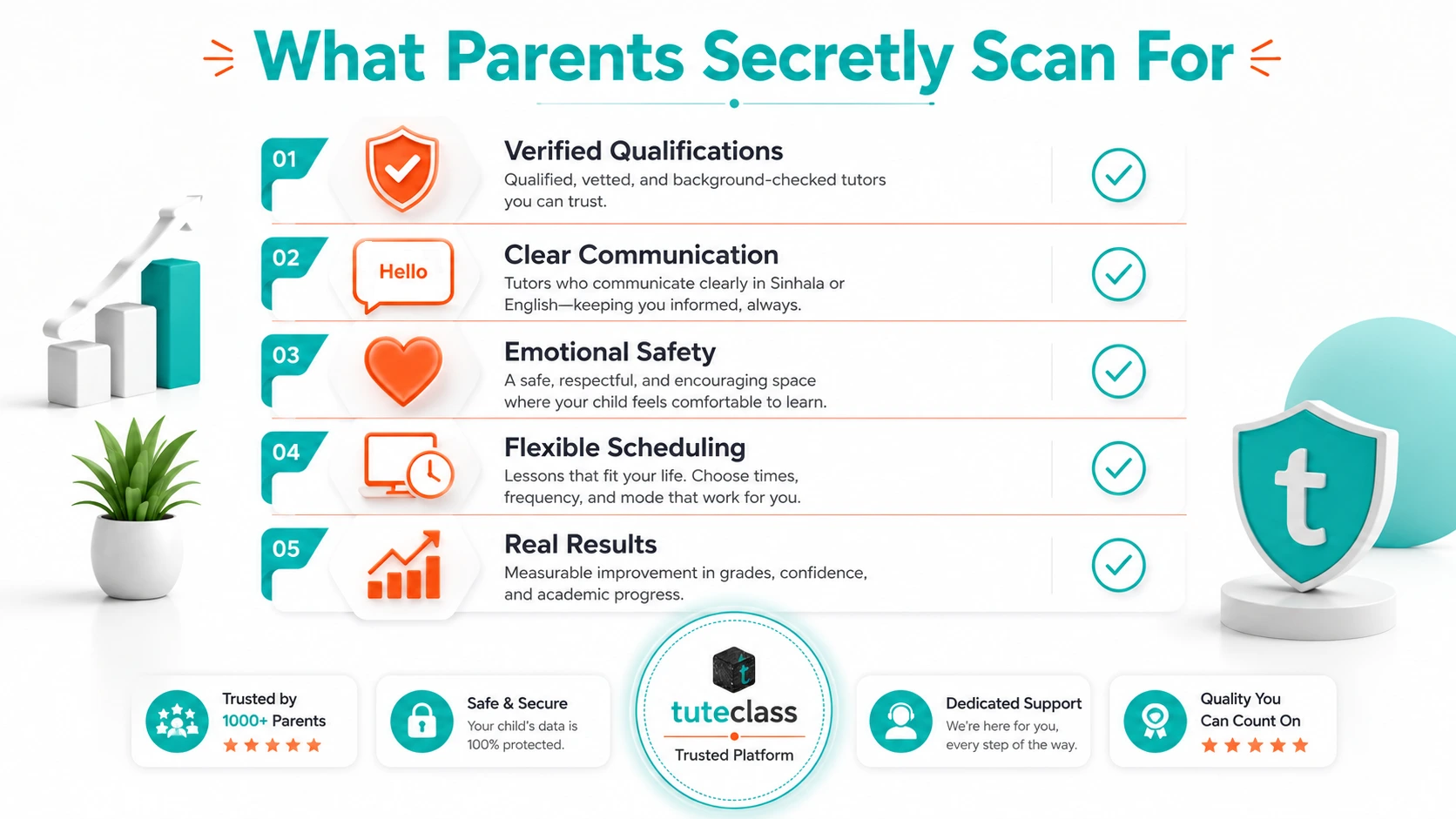
Parents want to know you're qualified, but they care more about proof than claims. A scanned certificate carries weight. A few honest lines about where you studied and how long you've been teaching. It's simple, but so many profiles skip it entirely.
They care about language, and not just which languages you speak. They want to know whether you can explain things clearly to a child who is struggling. One of the most common reasons students quit is that the tutor talks over their head and never circles back to fill the gaps. I've seen profiles that added a single line like "I explain concepts in Sinhala, Tamil, or English depending on what the student is most comfortable with" and immediately started getting more inquiries. It's such a small thing. But to a worried parent, it means a lot.
They want to know their child will be treated with patience. This sounds obvious, but most tutors never mention it. They assume parents know they're kind. Parents don't know. They're guessing. A short line in your bio about how you handle mistakes, or how you encourage questions, goes further than you'd think.
They also notice flexibility. Not that you're available at all hours, but that you understand families have complicated schedules. Mentioning that you offer both physical and online classes, or that you're open to discussing batch timings, broadens your reach. I've had parents tell me they chose a tutor simply because the profile said something like "I'm happy to adjust timings where possible to fit your child's schedule." That one line did more than any list of qualifications.
And parents are tired of big promises. They've heard "guaranteed A" too many times. What they respond to is quiet, specific evidence. A mention that most of your students improved last year. A short testimonial from a real parent. Something that feels true because it's specific, not because it's loud.
Research from Harvard Graduate School of Education has consistently shown that strong student-teacher relationships built on trust and emotional safety lead to better academic outcomes. A child who feels safe asks more questions. A child who asks more questions learns faster. It's that simple.
What Do Sri Lankan Students Want from a Tutor but Never Say?
Students are harder to read because they rarely complain directly. They just leave. Or they stay physically present but mentally check out.
Over the years I've spoken to enough of them to notice a few things. They want you to explain from the ground up, even if the syllabus assumes prior knowledge. The tutors they remember fondly are the ones who never made them feel stupid for asking a question they "should" already know. One boy told me about his maths tutor, "Sir never sighed when I asked something basic. He just drew another diagram and made me explain it back." I think about that all the time. He didn't remember the formulas. He remembered that his tutor never made him feel small.
Students also want to see their own progress, measured against where they started, not against the class topper. The shift from "you're still behind" to "look how far you've come" changes everything about their motivation.
Something else that rarely gets talked about is how much students notice whether a tutor actually remembers them. Not just their name, but the small things. The topic they struggled with last month. The exam they were nervous about. The fact that they play cricket or draw in their free time. I once asked a group of A-Level students what made them stick with a particular tutor, and one girl said something that stuck with me. "Miss remembered that I had my dancing competition the week before the test. She asked me how it went before we started the lesson." That was it. A thirty-second exchange. But that girl attended every single class after that, and she recommended that tutor to three of her friends. Tutors who treat students as whole people, not just grade entries, build loyalty that no competitor can touch. And the strange thing is, it costs nothing to mention on your profile that you take a genuine interest in your students' lives beyond the syllabus. Almost nobody does it.
There is a deeper layer to this that most tutors never consider. Students don't just want to be remembered. They want to feel that their tutor believes they are capable of something meaningful beyond the exam. In Sri Lanka, the pressure to perform academically is so intense that many students quietly internalise the idea that their entire worth depends on three letters on a results sheet. A tutor who occasionally says things like "I know this is hard, but I've seen you work through difficult topics before" or "you ask really thoughtful questions, and that matters more than getting everything right the first time" does something subtle but powerful. They unhook a student's self-worth from their marks. That kind of emotional scaffolding doesn't just improve grades. It changes how a young person sees themselves. I spoke to a mother in Kandy last year who told me her son had been on the verge of giving up on Chemistry entirely. He wasn't failing, but he was convinced he was "bad at it." She found a tutor through Tuteclass who, in the first month, sent her a short voice note saying her son had asked one of the best questions in the class that week. Not that he'd scored well. That he'd asked a great question. That one message reframed everything for that boy. He didn't become a brilliant chemist overnight, but he stopped hating the subject. He started showing up willingly. His grades improved gradually, but more importantly, his confidence came back. The mother told me she had recommended that tutor to six families in her neighbourhood. Not because of the results. Because of the voice note. Tutors who understand this dynamic don't just build classes. They build reputations that spread through word of mouth for years. And here is the part that still surprises me. You can hint at this quality on your profile without sounding boastful. A simple line like "I believe a student's confidence matters as much as their marks, and I try to build both" tells a parent everything they need to know. It tells them you see their child as a person, not a percentage. In a market where most profiles read like a list of achievements, that one sentence can be the reason a parent chooses you over ten other tutors who never thought to say it.
And yes, many students respond well to visual explanations. Short sketches, diagrams, screen shares. But not every student in Sri Lanka has fast internet or a personal device. UNICEF Sri Lanka's education programme has highlighted the ongoing digital divide affecting students outside urban areas, where connectivity and device access remain significant barriers. If you teach students in those areas, offer offline alternatives. Printable worksheets. Downloadable notes. Audio summaries that don't eat up data. Mention that on your profile. It tells parents you understand their reality. I've seen tutors in rural areas build incredibly loyal followings simply because they thought about this when nobody else did.
How to Create a Tuition Profile That Attracts Students in Sri Lanka
One of the reasons we built Tuteclass was to give tutors a place where they could present all of this clearly. Verification so parents know you're real. Space to describe your teaching style, not just your subjects. A way for parents to contact you without exposing your personal number. And a listing that stays visible for a full year without daily ad spend.
Tuteclass is a tool. It won't teach your classes for you. It won't manufacture trust where none exists. What it does is make it easier for the right families to find you and evaluate you honestly. The rest has always been on you.
Tips to Get More Tuition Students Without Paid Ads
If you already have a profile somewhere, look at it with fresh eyes. Would a tired parent scrolling at 10pm feel confident sending their child to you? If not, change a few things. Write your bio in your own voice. Say why you teach. Mention how you handle students who are falling behind. Upload a photo where you look like someone a child would feel safe with. If a parent ever thanked you, ask if you can share their words. These are small things. They take an hour, maybe two. But they change how people see you.
If you teach in areas where connectivity is a problem, say so on your profile. Mention that you provide offline materials, or that you keep online sessions light on data. Most tutors don't mention this at all, which is why it stands out when someone does.
Your Tuteclass profile is one place to do this work. But wherever you show up online, the principle is the same. Show enough of yourself that a parent can make a real decision, not a guess.
Sri Lanka's tuition market is crowded, and parents have more choices than ever before. But after watching thousands of interactions between families and tutors, I keep coming back to the same conclusion. Qualifications matter. Results matter. Experience matters. But trust is usually what starts the conversation. Your profile is often the first impression a family gets of you. Make sure it reflects the teacher you already are.