
I remember sitting in a crowded hall down in Nugegoda, watching someone flip through a marking scheme like it was a magazine just hours before the test. He had no idea what he was looking for. Two weeks later, same mistakes. I've seen this happen so many times I've lost count.
Most students treat past papers like a checklist. Finish one, move to the next, feel productive. Then the real paper comes and nothing sticks. The ones who improve aren't the ones who finish the most papers, they're the ones who slow down and study what they got wrong. It's annoying, it takes hours, and you'll hate doing it. But it's the only thing that moves your marks.
You sit down before you've properly learned the theory, open the first page, and nothing makes sense. So you close the book and tell yourself you'll do it later. Everyone's done this. You have to go back to the textbook section and actually work through the examples first. Then find past paper questions on that specific topic and try them with your notes open. You're not simulating exam conditions yet, you're just checking whether you actually understood what you studied. If you still can't answer with your notes beside you, the problem isn't the past paper. Go back to the theory.
Writing the correct answer beside the mistake and moving on feels like progress. It isn't. Sit with the mistake. Ask yourself what actually happened.
Did you not know the theory at all?
Did you misread the question?
Did you know the answer but explain it badly?
Was it a calculation error?
Did you run out of time?
Did you miss a keyword that changed what the question was really asking?
Each answer points to a different fix. If you didn't know the theory, go back to the textbook. If it was a calculation error, show more steps. If you ran out of time, practise more timed questions. If you missed a keyword, read the question twice before answering. In A/L Chemistry, you can lose marks on organic reaction mechanisms because you forgot a reagent, or you drew the wrong intermediate, or you failed to explain the reaction properly. Each one needs a different fix. So don't just write "Chemistry weak" in your notes. Write exactly what went wrong.
A student gets 62 marks, feels disappointed, and immediately starts another paper. If 15 of those lost marks came from just three topics, the next hour should go to those three topics. Not a new paper.
A marking scheme shows you how the marks are awarded. Not just the correct answer. When you mark your own answers, don't just check whether your final answer matches. Look at the language the scheme uses. Suppose a question asks you to "explain" and the marking scheme awards one mark for a correct statement and another for a supporting reason. A bare statement without a reason gets half marks. If a question asks you to "evaluate" and the scheme expects a judgment backed by justification, a simple description won't be enough.
Your tuition master will yell at you for not checking marking schemes properly. They know the game. So do you. If you're using a commercial past-paper book or a website, compare its answers with an official marking scheme when one is available. Check the Department of Examinations Sri Lanka website for official materials. You can also find official marking schemes and past papers on the Department of Examinations exam resources page.
Keep a small notebook for each subject. For every question you get wrong, write down three things: the topic, what went wrong, and what to do about it. No fancy format. If you keep messing up O/L Maths problems because you used the wrong formula, write "used wrong formula" and then "revise formula, do three similar questions." If it's A/L Chemistry and you forgot a reagent, write "forgot reagent" and "review reaction conditions." Be specific. "I'm bad at Chemistry" is useless. "I forgot to convert units in physical chemistry calculations" is something you can actually fix.
After a few weeks, look back. You'll see patterns. Maybe most of your Physics lost marks come from not showing enough working. Or maybe your Biology explanations are too vague for the marking scheme. Different problems, different fixes. And if you study in Sinhala or Tamil medium but practise with English papers, note that separately. Sometimes the problem isn't the subject, it's the language.
When you compare several years of O/L or A/L papers, you'll start noticing that some topics and question styles come up more often than others. You also get a feel for how much detail a four-mark question needs versus a ten-mark question. After five or six papers, start keeping a list. Write down which topics came up in each year. After a few papers, you'll see which areas appear more often and which appear less often. Use that to prioritise your revision. If a topic appears repeatedly, give it extra attention.
The National Institute of Education publishes the official syllabuses for each subject. You can check whether a recurring topic is actually a core part of the syllabus or just a common exam favourite. But don't use those patterns to predict the next paper. A topic that has appeared frequently can still be absent from the next paper. A topic that hasn't appeared recently can return. Use patterns to organise your revision, not to guess what will come up. School term-test papers can be useful here too. They give you extra practice with the types of questions your teachers think are important. Compare them with national past papers and see what overlaps.
Don't time every question from the beginning. Early on, your priority is getting the method right. Later, once you're comfortable with the syllabus, start doing complete papers against the clock. Starting with full timed papers can be frustrating if you're still learning the material. Practise using the actual time limit for the subject and paper you're preparing for. Check the instructions on the relevant examination paper rather than assuming every subject follows the same format. Five papers with careful review beats fifteen papers without checking your answers. Aim to complete enough full papers that you've practised the syllabus across different years and can finish within the time limit.
Before you start a paper, review the relevant topic. Keep the paper and marking scheme ready. Decide whether this attempt will be open-book, closed-book, or timed. First attempts should be open book. Later attempts should be closed book. Eventually, you should be doing them fully timed. After the paper, mark it. Record every lost mark in your mistake book. Categorise the mistakes. Re-study the weak areas. Reattempt the difficult questions a few days later. You can adapt this to O/L Maths or A/L Physics. For Combined Maths, you might lose marks for not showing enough steps. For A/L Accounting, you might lose marks for not labelling your workings clearly. The routine stays the same. The mistakes you look for will differ.
Past papers work well with two study techniques: active recall and spaced repetition. Active recall means testing yourself rather than re-reading your notes. Past papers naturally involve active recall because you have to retrieve information without looking at the answer first. Spaced repetition means revisiting material at increasing intervals. Instead of doing one past paper and moving on, review the questions you missed a few days later, then revisit them the following week. Revisiting difficult questions gives you another chance to retrieve the information instead of forgetting it after one study session. Your mistake book makes this easier because you already have a record of what to revisit.
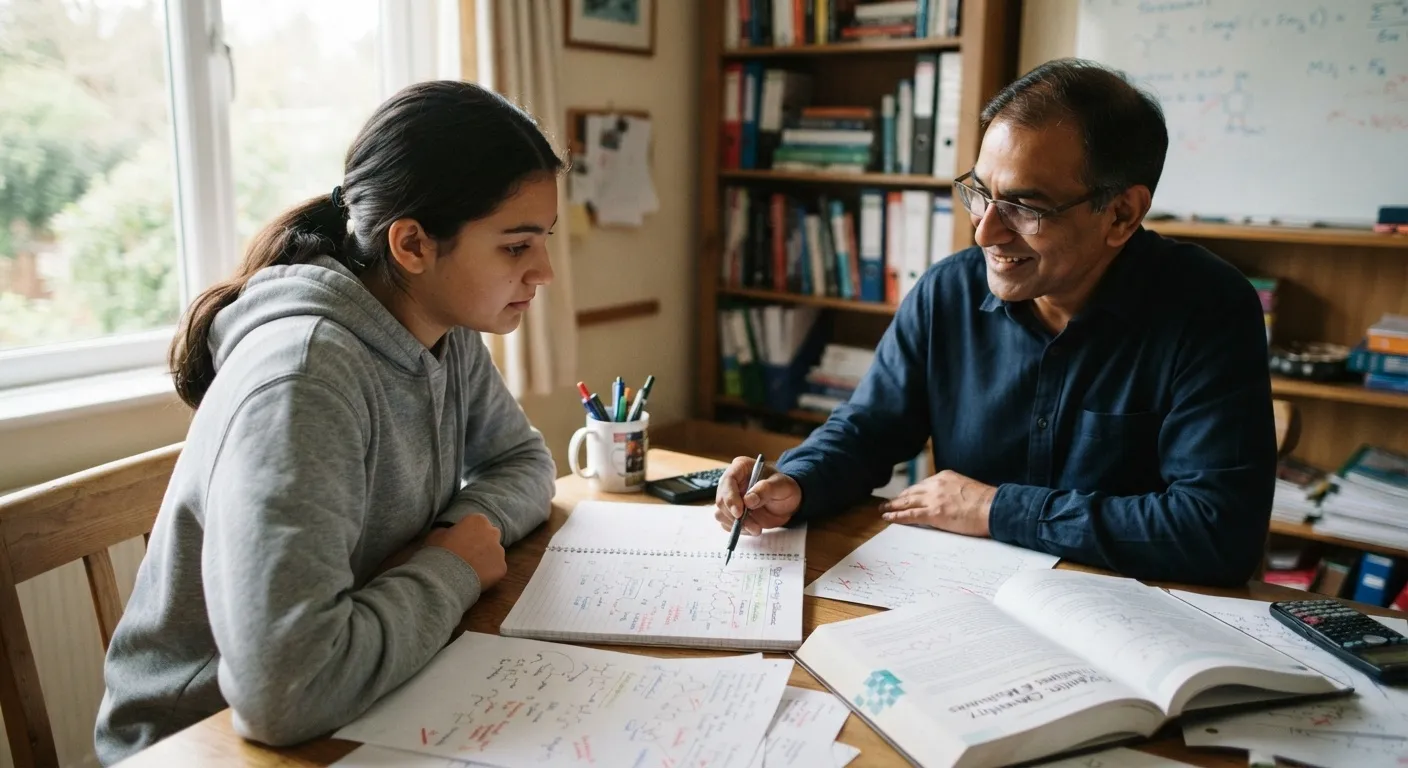
If your past-paper results show that you repeatedly struggle with the same topic despite revising it yourself, you may need help from a teacher or tutor. Sites like TuteClass are decent for tracking down O/L and A/L tutors or online classes, but only use them once your past papers show you exactly where you're bleeding marks.
Use your past-paper mistakes to identify what you actually need help with. Don't join a class simply because other students are doing so. If you consistently lose marks in organic chemistry mechanisms, a tutor can explain the concept in a way that a marking scheme cannot. But if your issue is running out of time, you may not need tuition at all. You may just need more timed practice. That way, tuition focuses on the topics you're actually struggling with rather than covering material you already understand.
You don't need to wait until the final few months. Start using past-paper questions as soon as you've finished enough theory to attempt them. There's no rule that says you have to finish the textbook before you touch a past paper. For O/L students, this can start once you've covered enough of the syllabus to practise meaningful questions. For A/L students, build the habit during the first year and increase the amount of full-paper practice as the exam approaches. If you're using school term-test papers alongside national past papers, start with whichever matches what you've already covered in class.
Don't collect papers. Learn from them.